Magento Migration SEO: What You Risk Losing in Rankings and How to Protect It Through a Platform Move

Key Highlights:
- A Magento migration or new-store launch can quietly erase years of accumulated search rankings when URL structure, redirects, and canonical tags are treated as an afterthought instead of a planned workstream.
- A pre-migration Magento SEO checklist maps every legacy URL to its new destination before cutover, so redirects, canonicals, and sitemap updates ship with the platform rather than being patched in afterward.
- Retailers that protect rankings through cutover keep their organic traffic curve intact instead of spending months rebuilding authority the migration itself put at risk.
- Sigma runs SEO mapping as part of the migration engineering work itself, not as a separate post-launch cleanup project handed to marketing after the fact.
Introduction:
A Magento migration, whether moving from Magento 1 to Magento 2, consolidating platforms after an acquisition, or replatforming for performance reasons, is an engineering project with a search visibility risk attached to it that most project plans do not name explicitly. URLs change, category structures get reorganized, and canonical logic gets rebuilt from scratch, and each of those changes can break the signals search engines use to rank the store. Magento migration SEO is the discipline of protecting that ranking equity through the move rather than rebuilding it afterward.
Why Migrations Quietly Tank Search Rankings
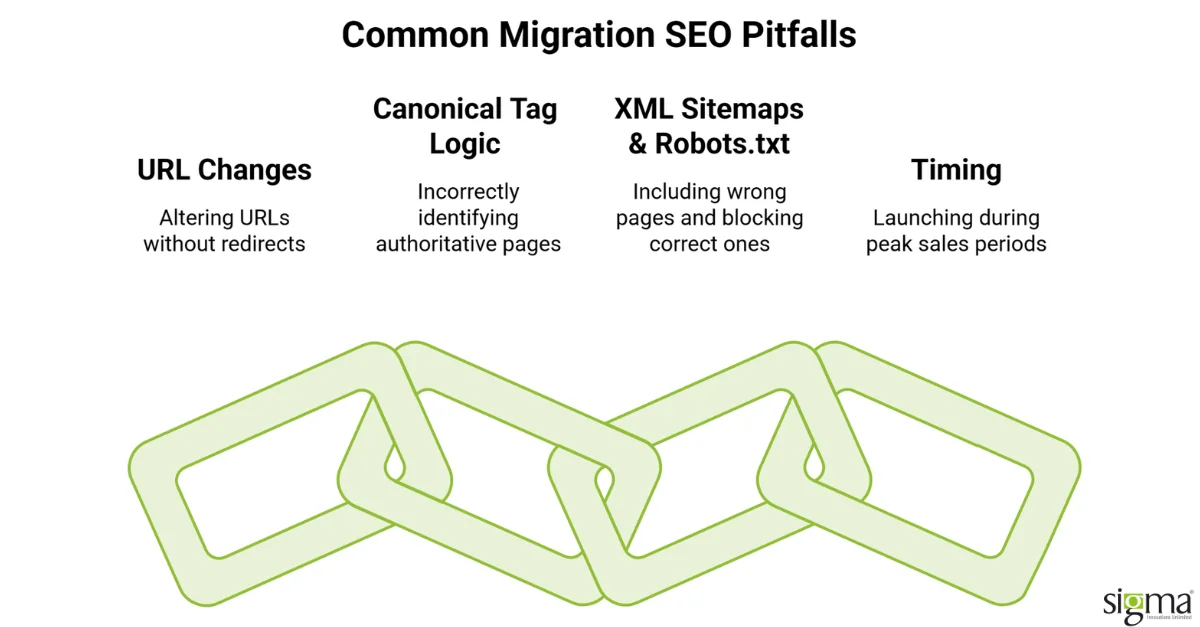
Search engines rank URLs, not brands, which means a migration that changes URL structure without a redirect plan is effectively asking Google to start ranking the store from zero. This happens more often than migration teams expect, because URL changes are usually a side effect of other decisions: a new category taxonomy, a cleaner slug format, a platform’s default routing, rather than a deliberate SEO choice, and nobody on the project maps the before-and-after URL list until it is too late to plan redirects properly.
Canonical tag logic is the second common failure point. A freshly migrated Magento store frequently generates canonical tags differently than the old platform did, sometimes pointing to the wrong version of a page, sometimes missing entirely on category or filtered pages. Search engines treat inconsistent canonical signals as a sign the site itself is unsure which page is authoritative, which dilutes ranking strength across duplicate versions rather than concentrating it where it belongs. This is invisible in a staging environment unless someone is specifically checking for it, which is why it tends to surface only after launch, once the damage is already reflected in search console data.
XML sitemaps and robots.txt are the third quiet failure point. A migration frequently regenerates the sitemap automatically from the new platform’s defaults, which can accidentally include pages that should stay out of the index, staging artifacts, internal search results, and duplicate filter combinations, while omitting pages that should be prioritized. A robots.txt file copied over without review can carry disallow rules written for the old platform’s URL structure that no longer make sense, or can be missing rules the new platform needs. None of these are complex fixes individually, but each one left unchecked compounds the ranking damage from the others.
Timing compounds all three risks further. A migration scheduled to finish just before a peak sales period leaves no buffer to catch and correct a broken redirect map or a canonical misconfiguration before the traffic that matters most arrives. The same technical issues that are a manageable annoyance in a slow month become a materially larger revenue problem when they coincide with the weeks a retailer depends on organic search the most, which is why Magento migration SEO planning belongs on the project timeline from the start rather than as a task added once the engineering work is already underway.
The Pre-Migration SEO Checklist: What Breaks and How to Protect It
Not every migration risk carries equal weight, and planning the protection work against the actual failure modes, rather than a generic checklist, is what keeps a migration timeline realistic. The table below maps the risks Sigma checks before every Magento cutover.
| Migration Risk | What Breaks Without Protection | Protection Step |
|---|---|---|
| URL structure changes | 404s replace ranking pages, link authority lost | Full legacy-to-new 301 redirect map, tested before cutover |
| Canonical tag regeneration | Duplicate content signals, diluted ranking strength | Canonical audit on category, product, and filtered pages post-migration |
| XML sitemap regeneration | Wrong pages indexed, priority pages omitted | Manual sitemap review before submission to Search Console |
| Robots.txt carried over unreviewed | Blocked pages that should rank, or crawlable pages that should not | Line-by-line robots.txt review against new URL structure |
| Content and metadata loss during transfer | Duplicate or missing meta titles and descriptions | Metadata field mapping verified in a staging environment before go-live |
What to Protect During Cutover
The redirect map deserves the most planning time of any item on the checklist, because it is the single highest-leverage protection available and the easiest to get wrong under deadline pressure. Every indexed URL on the legacy site, not just the obvious category and product pages, needs a mapped destination on the new platform, including blog posts, landing pages, and any filtered or paginated URLs that happen to carry inbound links or organic traffic.
Canonical tags need explicit verification immediately after the new platform goes live, not assumed correct because the migration vendor said the platform “handles SEO automatically.” Checking a sample of category, product, and filtered pages against expected canonical output catches misconfiguration before search engines have crawled enough of the new site to reflect the problem in rankings. Metadata, page titles, meta descriptions, and structured data need the same verification, since a bulk data migration frequently drops custom metadata fields in favor of platform defaults unless the mapping is checked field by field before launch.
Post-Launch: Monitoring and the Recovery Window
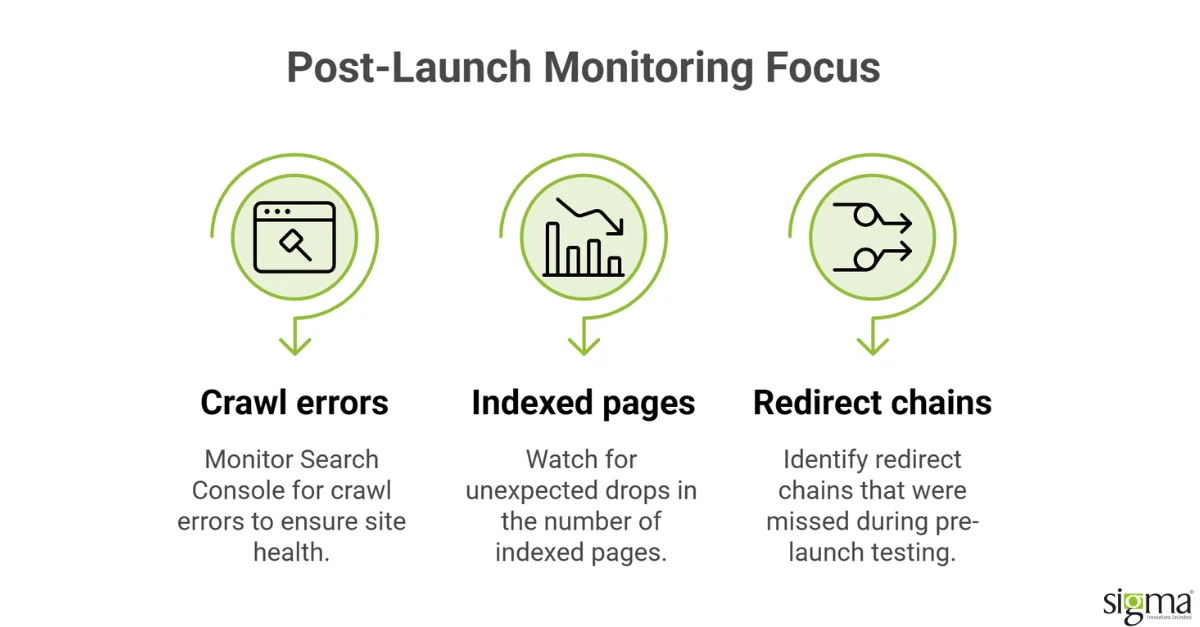
Even a well-planned migration produces a short period of ranking volatility while search engines recrawl and reindex the new URL structure, which is normal and not a sign the migration failed. What matters is monitoring Search Console for crawl errors, unexpected drops in indexed pages, and redirect chains that were not caught in the pre-launch testing, so any real problem is caught and corrected within days rather than discovered a month later in a traffic report.
Protecting Rankings Through a Magento Migration, Step by Step
Sigma builds SEO mapping into the migration engineering plan itself rather than treating it as a separate workstream marketing has to chase after launch. The redirect map, canonical audit, and sitemap review are deliverables inside the migration scope, verified in staging before cutover and rechecked in the first weeks after go-live. Sigma’s platform upgrade for an Irish grocery retailer, moving the store across ten Magento version releases and 35 patches to a new AWS infrastructure, protected search visibility and business performance through the cutover, with order volume up 15 percent and revenue up 10 percent following the migration, alongside a 400 percent improvement in mobile performance.
That engagement protected rankings through a theme and infrastructure upgrade; the same discipline applies at greater scale during a full platform migration.
Both migrations protected the ranking equity a platform change puts at risk by treating SEO as a technical requirement of the migration plan, not a cleanup task for after launch. The grocery retailer’s theme upgrade preserved and improved organic performance through the change; Hansen Wholesale’s platform migration did the same during a full module rebuild. Migrations that leave SEO for later tend to lose the ground this approach protects.
How Sigma Infosolutions Protects SEO Through Magento Migrations
Sigma Infosolutions includes SEO preservation as a defined workstream in every Magento migration engagement. Sigma’s process covers pre-migration crawl benchmarking, redirect map development, canonical configuration, structured data preservation, and post-migration monitoring to detect and respond to ranking changes before they compound.
If you are planning a Magento migration and want to ensure that your organic rankings and crawl equity are protected through the transition, speak with Sigma Infosolutions. Sigma’s Magento and SEO engineering teams can structure the migration to include SEO preservation as a first-class deliverable rather than a post-launch remediation item.
For CTOs and engineering directors managing a Magento platform migration, the executive-level business consequence of inadequate SEO protection is specific: organic search is typically a store’s largest or second-largest revenue channel, and a migration that loses accumulated ranking equity costs real revenue for as long as recovery takes, which historically ranges from three to twelve months depending on the severity of the technical errors introduced. The business case for building SEO planning into the migration scope, rather than treating it as a post-launch cleanup, is straightforward: the cost of the redirect map, the canonical audit, and the monitoring window is consistently lower than the revenue impact of a ranking drop that a proper checklist would have prevented. The trade-off in treating SEO as a migration deliverable is that it adds scope to an already complex project and requires close coordination between the engineering team and the SEO team throughout the build phase rather than only at launch.
Sigma Infosolutions builds Magento migration SEO protection into the engineering scope itself rather than treating it as a separate cleanup engagement after launch. If you are planning a Magento replatform or platform consolidation and need a partner who will own both the migration engineering and the SEO continuity through cutover, speak with Sigma’s Magento and SEO practice to scope the engagement.
Conclusion:
A Magento migration is an engineering project with a search visibility outcome attached, and treating that outcome as an afterthought is the single most common reason a technically successful migration still loses organic traffic. URL structure changes, canonical tag regeneration, sitemap defaults, and robots.txt carryover are the four places rankings most often break during a platform move. Each one is preventable with a checklist item and a staging-environment verification step rather than a post-launch scramble. The redirect map is the highest-leverage protection on that checklist, since a missing redirect is the most direct way link authority and ranking signal get lost during cutover. Canonical tags and metadata need the same explicit verification, since assuming a new platform “handles SEO automatically” is how quiet regressions go unnoticed until a traffic report surfaces them. A defined monitoring window after go-live catches the remaining volatility before it compounds into a lasting loss. Magento migration SEO done well means a store’s search visibility curve barely dips through a cutover that would otherwise reset months of accumulated ranking equity. Sigma builds this protection into the migration engineering scope itself rather than as a separate cleanup project. Retailers planning a Magento migration or platform consolidation should treat the redirect map and canonical audit as launch requirements, not optional add-ons. Skipping that planning step rarely saves time overall, since the recovery work after a ranking drop takes longer than the checklist would have. A migration that protects rankings through cutover reaches its performance goals without also reopening a search visibility problem the business had already solved.
Frequently Asked Questions
What SEO risks should I plan for during a Magento migration?
The four highest-risk areas are URL structure changes without a redirect map, canonical tag regeneration that creates duplicate content signals, XML sitemap defaults that index the wrong pages, and robots.txt rules carried over from the old platform. Each is preventable with a checklist item verified in staging before cutover.
How do redirects protect rankings during a Magento 2 migration?
A 301 redirect map passes link authority and ranking signal from every legacy URL to its new destination, so search engines treat the new page as a continuation rather than a brand-new, unranked page. Without a complete redirect map, old URLs return 404 errors and the authority they carried is lost entirely.
Should SEO work happen before or after a Magento store launch?
Before. Redirect mapping, canonical configuration, and sitemap review need to be verified in a staging environment and ready to go live with the platform itself. Treating SEO as a post-launch cleanup task means rankings drop first and get rebuilt later, which costs far more time than planning it upfront.
How long does search traffic take to recover after a Magento migration?
A well-planned migration with a tested redirect map and verified canonicals typically shows minimal, short-lived volatility as search engines recrawl the new URL structure, often settling within two to four weeks. A migration without that planning can take several months to recover lost rankings, if it fully recovers at all.
What is Enhanced SEO Migration and do I need it?
Enhanced SEO Migration is a structured review of the existing site’s SEO setup, redirects, canonicals, sitemap, and metadata, paired with specific recommendations for preserving that equity on the new platform. Any store with meaningful organic traffic or accumulated backlinks should treat this as a required part of migration planning, not an optional add-on.