Salesforce Release Governance: A Framework That Prevents Disruption for Service Cloud Teams
Key Highlights:
- Seasonal Salesforce releases arrive whether or not a growth-stage SaaS or FinTech IT team has evaluated their impact on live support and revenue operations.
- Salesforce release governance is a repeatable process for triaging, testing, and adopting seasonal changes deliberately, not reactively.
Teams with this process in place capture new capabilities faster while avoiding the disruption that untested changes cause in production, exactly when support volume is scaling with the business. - Sigma has built the governance and testing discipline that lets support and operations teams treat releases as planned events.
Introduction
Salesforce ships three major seasonal releases a year, and each one lands on every org running the platform whether or not the IT team has evaluated what it actually changes for their specific configuration and its downstream effects. The risk is highest for growth-stage SaaS and FinTech companies that run Salesforce as the operational backbone of both their support organization and their revenue engine, since these are also the companies scaling headcount and customization fastest, which widens the gap between what the platform assumes and what the org actually has configured. Salesforce release governance is the discipline of triaging what each release contains, testing the changes that touch active workflows before they go live, and adopting new capabilities deliberately rather than discovering a behavior change in production because nobody reviewed the release notes in time. Teams running Service Cloud for live customer support have the most to lose from an ungoverned release, since a broken flow or an unexpected default configuration change can disrupt case handling for every agent at once during a busy shift.
Salesforce changes shouldn’t become production risks.
Why Support Operations Carry the Highest Release Risk
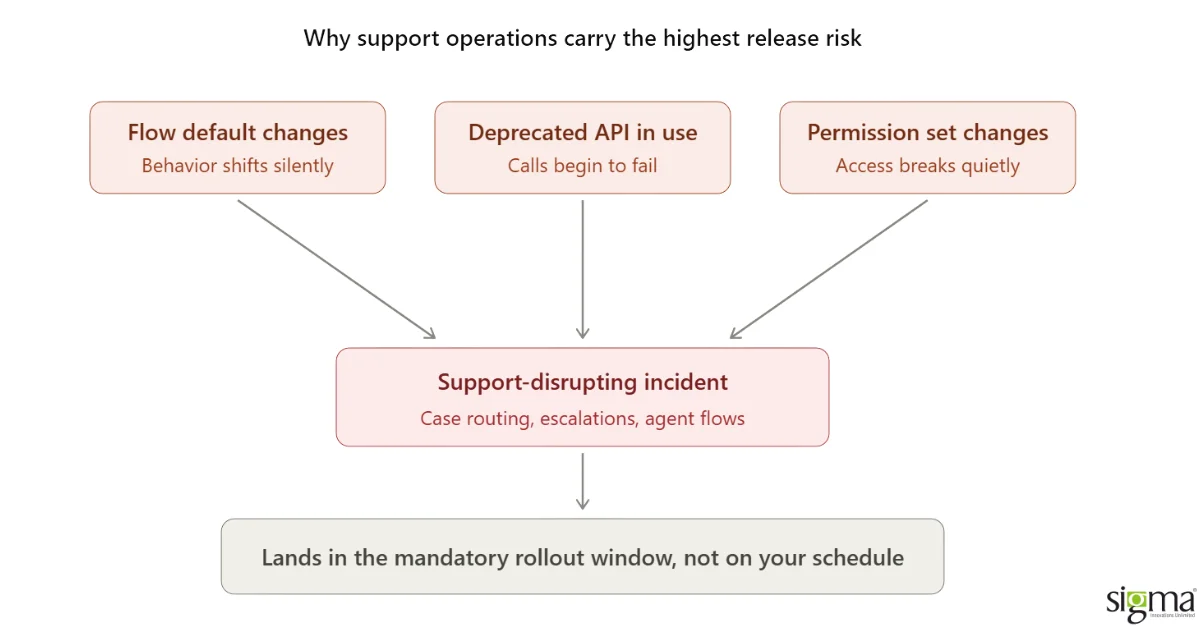
Service Cloud configurations tend to be deeply customized around case routing, escalation rules, and agent-facing flows that were built to match a specific support operation’s workflow, which makes them more sensitive to seasonal changes than a simpler Sales Cloud setup might be. A release that changes default behavior for a flow element, deprecates an API version still in use, or alters how a permission set interacts with a custom object can surface as a support-disrupting incident precisely when the org is not prepared for it, often during the release’s mandatory rollout window rather than at a time the team would have otherwise chosen for a planned change. Teams that treat every release as routine, without checking it against their specific customizations, are the ones most likely to be caught off guard.
Building a Salesforce Release Governance Triage Process That Fits a Real Release Calendar
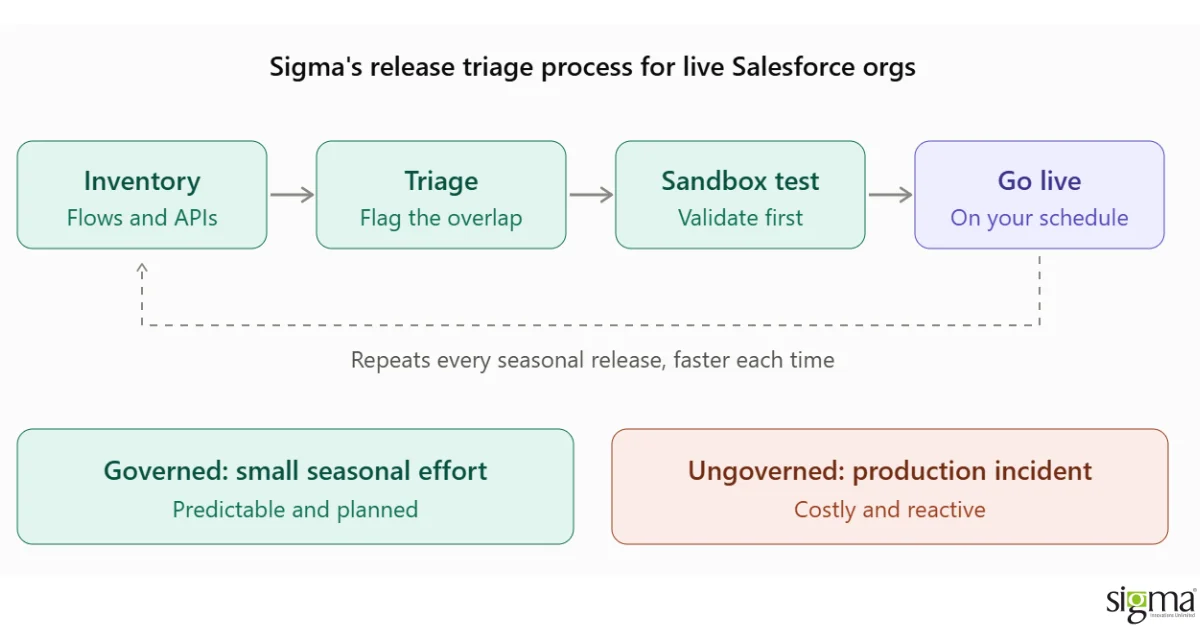
A workable triage process does not require reviewing every line of Salesforce’s release notes in full; it requires a structured filter that surfaces only the changes relevant to the org’s actual configuration and active customizations. That filter typically checks release notes against a maintained inventory of the org’s custom flows, active integrations, and any deprecated features still in use, flagging only the intersection for deeper review rather than treating the full release as equally relevant across every part of the org. Teams that build this filter once and maintain it release over release spend a fraction of the time on triage that teams starting from scratch each season spend, while consistently catching a higher share of the changes that actually matter to their specific configuration and workflows.
Comparing a Reactive Approach to a Governed One
| Approach | Reactive (No Governance Process) | Governed Release Process |
|---|---|---|
| Release Review | Skipped or done after issues appear | Structured triage before go-live |
| Testing | None, or only after a production issue | Sandbox testing on flagged changes |
| Rollout Timing | Whatever Salesforce schedules by default | Deliberately scheduled around support peaks |
| Team Impact | Agents discover changes mid-shift | Changes communicated and trained in advance |
Testing in Sandbox Before the Mandatory Rollout Window
Salesforce provides a preview window before each release becomes mandatory, and testing flagged changes in a sandbox environment during that window is the single highest-leverage step in the entire governance process, since it turns an unknown risk into a known, manageable one before it reaches production. This is particularly important for anything touching Service Cloud’s case routing or escalation logic, where a subtle behavior change can go unnoticed in testing but disrupt real customer interactions once live. Teams that consistently skip sandbox testing, citing time pressure, are trading a small, predictable time investment now for a larger, unpredictable disruption later.
That kind of deep Service Cloud customization is exactly where release governance matters most, since heavily customized configurations are the ones most likely to interact unexpectedly with a seasonal platform change.
Communicating Changes to the Teams Who Actually Use the Platform
Governance is not complete once a technical review is finished; the changes that affect how agents or sales reps work day to day need to be communicated and, where relevant, trained on before the release goes live for end users. A release that technically passed sandbox testing but was never communicated to the support team still creates disruption, just in the form of confused agents rather than broken flows, which is a preventable cost with a small amount of advance communication built into the governance process from the start. Building a short release summary for end users, distinct from the technical triage document used internally, is a low-effort step that consistently prevents this second, quieter form of disruption.
Read the blog: Salesforce Integration Architecture: Why Point-to-Point Breaks as You Scale and How to Choose the Right Model
The Release Triage Process Sigma Maintains for Live Salesforce Orgs
Sigma Infosolutions works with growth-stage SaaS and FinTech organizations running customized Salesforce implementations, including Service Cloud configurations built around complex support workflows, to build the release governance and sandbox testing discipline that lets teams adopt seasonal changes on their own schedule rather than reacting to them after deployment. That work includes deep Service Cloud customization, such as integrating Voice capabilities with contact center infrastructure, where release governance is essential to protecting a live, heavily configured support operation as headcount and case volume scale.
Teams that build this discipline once tend to keep it running with a modest, predictable time investment each season, which is considerably less costly than the alternative of managing an unplanned production incident after every major release.
Read the blog: Salesforce Implementation Cost in 2026: What to Expect and How to Plan Your Investment
Applying the Same Governance Process to Every Seasonal Release
The framework described here is not specific to a single release; it is designed to run the same way every season, regardless of which specific features a given release happens to introduce. That consistency is what makes governance sustainable rather than a burst of effort that fades after the first release or two. A team that maintains its custom flow and integration inventory continuously, rather than rebuilding it from scratch each season, finds that triage gets faster over time rather than staying at a fixed cost, since the inventory itself becomes more accurate and the team becomes more practiced at spotting which release notes actually intersect with their configuration.
For Salesforce admins, release managers, and IT leaders, release governance is not optional overhead, it is the control that prevents a routine seasonal update from breaking a production workflow. Technology leaders responsible for Service Cloud uptime should treat a governance framework as part of the platform’s operating cost, not an optional add-on.
Conclusion
Salesforce release governance turns three unpredictable seasonal events a year into a repeatable, manageable process rather than a recurring source of production risk. Support operations running on Service Cloud carry the highest release risk, since deeply customized case routing and escalation logic are more likely to interact unexpectedly with a seasonal platform change than a simpler configuration would be. A workable triage process does not require reviewing every release note in full; it requires a maintained filter that surfaces only the changes relevant to the org’s actual configuration for deeper review. Testing flagged changes in a sandbox environment during the preview window is the single highest-leverage step in the process, turning an unknown risk into a known, manageable one before it reaches production. Teams that skip this step are trading a small, predictable time investment now for a larger, unpredictable disruption once the release becomes mandatory. Governance is not complete once the technical review finishes; changes affecting how agents or reps work day to day need to be communicated and, where relevant, trained on before end users encounter them live. A release that passes sandbox testing but was never communicated to the team still creates disruption, just in a different form than a broken flow would. Teams that build this discipline once tend to maintain it with a modest, predictable time investment each season going forward, since the underlying process does not change from one release to the next. That investment is considerably smaller than the cost of managing an unplanned production incident after a release nobody reviewed in advance. This same structured process applies consistently to every seasonal release, regardless of which specific capabilities a given season happens to introduce. The goal of release governance is not to slow down adoption of new Salesforce capabilities, but to adopt them on a schedule the team controls rather than one dictated by an unreviewed default rollout that catches everyone off guard.
Keep Salesforce Releases on Track
Manage release risk with Sigma’s Salesforce Services. Talk to Sigma’s Salesforce Team
Frequently Asked Questions
Q: How much time should a team budget for reviewing each Salesforce seasonal release?
This depends heavily on configuration complexity, but a team with a maintained inventory of custom flows and integrations can typically complete triage in a few hours per release, since the filter narrows review to only the changes relevant to their specific setup rather than reviewing the entire release in full.
Q: What is the biggest risk of skipping sandbox testing before a mandatory release?
The biggest risk is discovering a behavior change in production, during live customer interactions, rather than in a controlled test environment beforehand where it can be fixed quietly. This is particularly costly for Service Cloud configurations where case routing or escalation logic disruptions affect every agent simultaneously during a shift.
Q: Do all Salesforce releases require the same level of governance review?
No. Releases vary in how much they touch a specific org’s configuration, and a structured triage filter should surface only the relevant changes for deeper review. A release touching heavily customized areas like case routing warrants more scrutiny than one affecting features the org does not use.
Q: How far in advance should end users be told about upcoming Salesforce changes?
Communication should happen after sandbox testing confirms the change’s actual impact, typically during the preview window before the release becomes mandatory for the org’s production environment. This gives support or sales teams enough advance notice to adjust their workflows without last-minute confusion during a live shift.
Q: Can a small IT team realistically maintain a release governance process without dedicated Salesforce staff?
Yes, particularly by maintaining a lightweight inventory of custom flows and integrations that gets checked against each release’s notes as they are published each season. A partner with Salesforce governance experience can also support the sandbox testing and triage work without requiring a full-time internal hire.